Test
- testing
- testing
Burmese Pythons: Gentle Giants, Real Facts, and Why They Matter
If you’ve ever seen a Burmese python up close, you know the feeling: part awe, part “how is something that big even real?” They’re one of the most famous snakes in the world for a reason. They’re powerful, beautiful, and (when cared for properly) surprisingly calm.
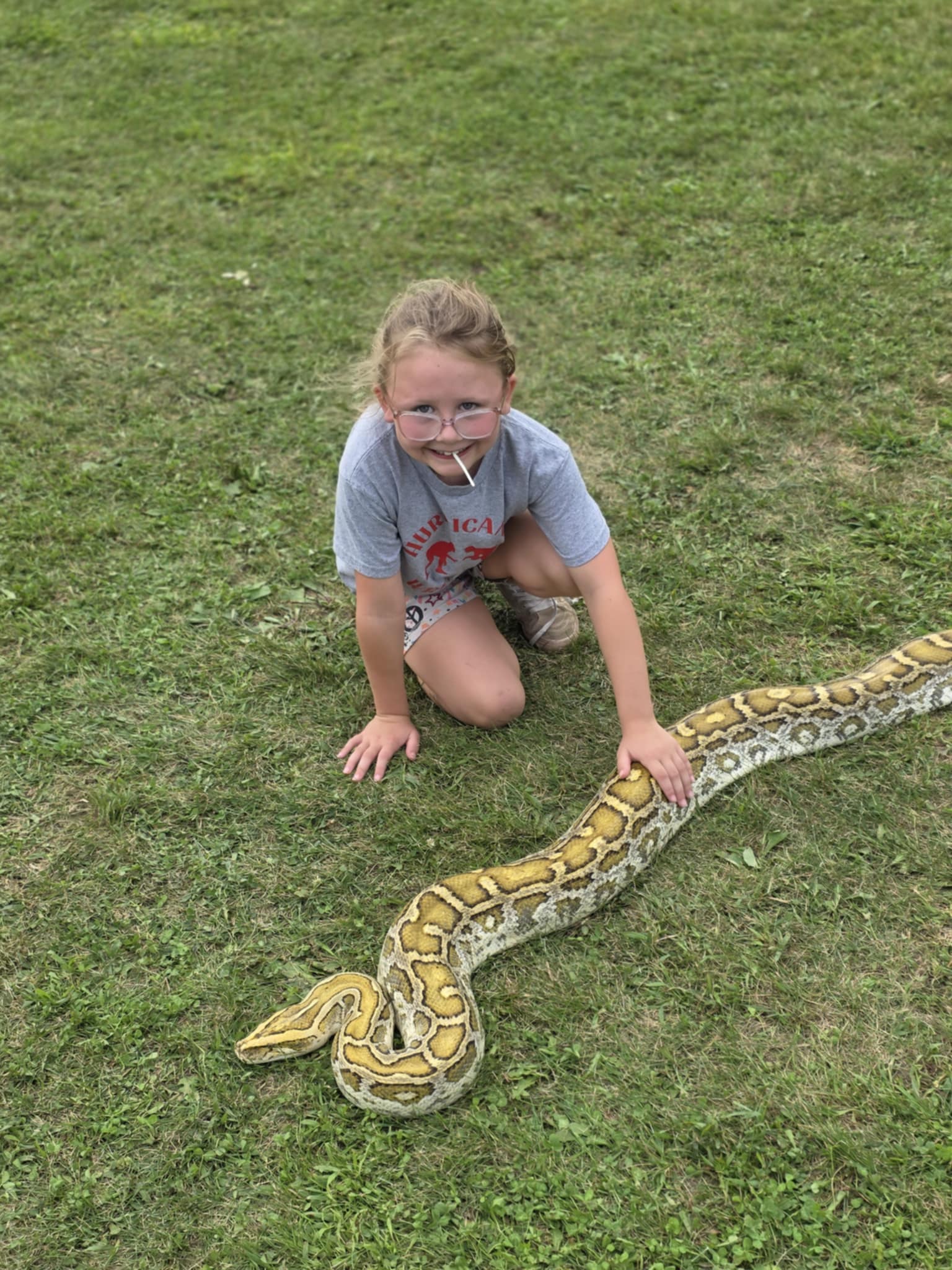
At Repterience, we use animals like Toast (our Hypo Burmese python) to help people replace fear with facts. Not because everyone needs to love snakes—but because understanding them makes us better neighbors in the natural world.
What is a Burmese python?
Burmese pythons (Python bivittatus) are large, non-venomous constrictor snakes originally from Southeast Asia. They’re built for strength: thick-bodied, muscular, and patient. They don’t “hunt” the way people imagine in movies. They rely on stealth and timing.
In the wild, their pattern helps them blend into forests, grasslands, and wetlands. In captivity, that same pattern is a big reason people are drawn to them—especially morphs like albino.
How big do Burmese pythons get?
This is the question everyone asks first—and for good reason.
Adult Burmese pythons can reach impressive lengths, and they’re heavy-bodied compared to many other snakes. They don’t look “long and skinny.” They look like what they are: a serious animal.
That said, size varies a lot based on genetics, sex, diet, and overall care. The biggest takeaway isn’t a specific number—it’s this: a Burmese python is not a “starter snake.” They require planning, space, and confidence.
Are Burmese pythons dangerous?
Here’s the honest answer: any large animal deserves respect.
Burmese pythons are not venomous. They don’t have fangs designed to inject venom. They’re constrictors, which means they subdue prey by wrapping and applying pressure.
But “not venomous” doesn’t mean “harmless.” A large python is strong, and strength plus poor handling is where problems happen. The good news is that with proper husbandry, safe handling practices, and adult supervision, they can be calm, steady animals.
What do Burmese pythons eat?
Burmese pythons are carnivores. In the wild, they eat animals they can overpower—typically mammals and birds.
In professional care, feeding is controlled, scheduled, and based on the snake’s size, age, and body condition. One of the biggest misconceptions we hear is that snakes “need to eat all the time.” In reality, many snakes do best on a consistent schedule that supports healthy growth without overfeeding.
How do they sense the world?
One of the coolest things about pythons is that they don’t experience the world like we do.
- They “smell” with their tongue. That tongue flick isn’t a nervous habit—it’s information gathering.
- They feel vibrations. Movement through the ground can tell them a lot.
- They have heat-sensing pits. Many pythons can detect warmth, which helps them locate prey.
When people learn this, they stop seeing a snake as “creepy” and start seeing it as a specialized, highly-adapted animal.
Why Burmese pythons are so misunderstood
A lot of fear comes from not knowing what you’re looking at.
People often assume:
- A big snake is automatically aggressive.
- A snake wants to chase you.
- Snakes are “slimy.”
In reality:
- Most snakes would rather avoid conflict.
- Snakes don’t chase people the way movies suggest.
- Snakes are dry-scaled and surprisingly smooth.
When kids (and adults) get a chance to see a python calmly, with a guide explaining what’s happening, the story changes fast.
The real responsibility of keeping a large snake
If you’re considering a Burmese python as a pet, the best thing you can do is plan like an adult animal owner, not like a shopper.
Ask yourself:
- Do I have space for an enclosure that supports a large, heavy-bodied snake?
- Can I maintain proper heat, humidity, and enrichment long-term?
- Do I have a vet plan?
- Do I have help for safe handling when the snake is larger?
Big snakes can live a long time. The commitment is real—and it should be.
Why we include Burmese pythons in education programs
Because they create a moment people remember.
A Burmese python helps teach:
- Respect for wildlife
- How ecosystems work
- Why myths spread (and how to replace them with facts)
- How to stay safe and calm around animals
And honestly? They also teach confidence. We’ve seen students go from “nope” to “I did it!” in a single program—because they were supported, not pressured.
Want to meet Toast in person?
If you’re a school, library, or event organizer in Wisconsin (and surrounding areas), Repterience offers hands-on reptile education programs that are safe, structured, and built for your audience.
If you’d like to bring a program to your group, reach out through our website and tell us:
- Your location
- Your audience size/age range
- Your preferred date range
We’ll recommend the best program format and make it easy to book.